A suspension concentrate insecticide for use in crops as listed to control a variety of mites as indicated.

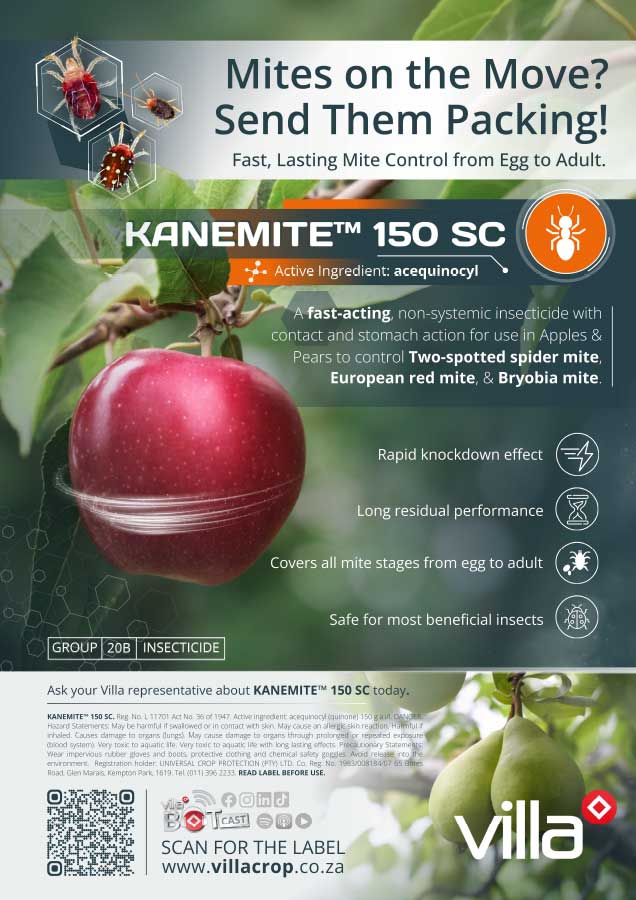
Apples & Pears
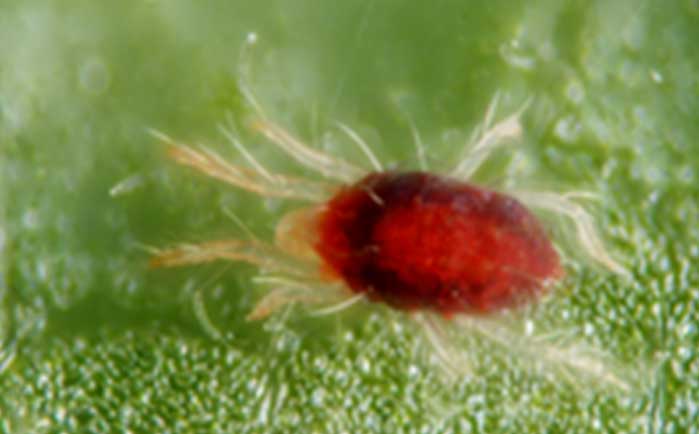
  • KANEMITE™ 150 SC is a suspension concentrate insecticide for use in Apples & Pears to control Two-spotted spider mite (Tetranychus urticae), European red mite (Panonychus ulmi) and Bryobia mite
    (Bryobia rubrioculus).
  • KANEMITE™ 150 SC is a fast-acting, non-systemic insecticide with contact and stomach action.
  • Acequinocyl belongs to IRAC Group 20B.
  • Acequinocyl inhibits electron transfer by binding to Complex III in mitochondria.
  • Rapid knockdown effect.
  • Long residual performance.
  • Covers all mite stages from egg to adult.
  • Safe for most beneficial insects.
  • PHI = 14 days.
  • The active ingredient acequinocyl controls various mite species through a fast-acting, non-systemic contact and stomach action.
  • Apply a total of two (2) applications only.
  • The first application must be applied when the first population of Mites are noticed with a threshold level of not more than 2 to 5 mites per leaf.
  • Apply the second application 21 days later if the mite population tends to increase.
  • The efficacy of KANEMITE™ 150 SC can be affected by very hard water (>1000 ppm.)
  • Water with a very high OR low pH can negatively influence the efficacy of KANEMITE™ 150 SC.
  • Ideally, the water pH should be in a pH range of 5 to 6.5.
  • When the spray water is above or below these criteria, it must be corrected with a suitable buffering agent.
  • Water volumes applied per hectare based on the Tree Row Volume (TRV) formula described by Unrath.
  • Ensure complete coverage of the tree canopy as well as the fruits.

KANEMITE™ 150 SC dosage rate: 35ml / 100 l water

N/A

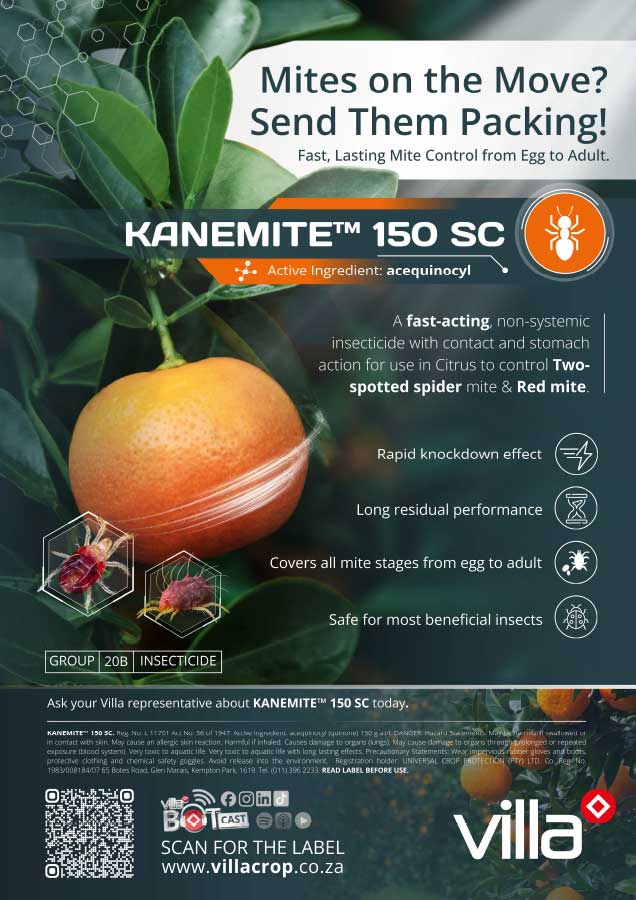
Citrus
  • KANEMITE™ 150 SC is a suspension concentrate insecticide for use in Citrus to control Two-spotted spider
    mite (Tetranychus urticae) and Red mite (Panonychus citri).
  • KANEMITE™ 150 SC is a fast-acting, non-systemic insecticide with contact and stomach action.
  • Acequinocyl belongs to IRAC Group 20B.
  • Acequinocyl inhibits electron transfer by binding to Complex III in mitochondria.
  • Rapid knockdown effect.
  • Long residual performance.
  • Covers all mite stages from egg to adult.
  • Safe for most beneficial insects.
  • No cross-resistance with conventional miticides.
  • PHI = 7 days.
  • The active ingredient acequinocyl controls various mite species through a fast-acting, non-systemic contact and stomach action.
  • Apply a total of two (2) applications only.
  • The first application must be applied when the first signs of crawler movement of Mites are noticed.
  • Apply the second application 21 days later if the mite population tends to increase.
  • The efficacy of KANEMITE™ 150 SC can be affected by very hard water (>1000 ppm.)
  • Water with a very high OR low pH can negatively influence the efficacy of KANEMITE™ 150 SC.
  • Ideally, the water pH should be in a pH range of 5 to 6.5.
  • When the spray water is above or below these criteria, it must be corrected with a suitable buffering agent.

KANEMITE™ 150 SC dosage rate: 35ml / 100 l water

N/A
Stone fruit
  • KANEMITE™ 150 SC is a suspension concentrate insecticide for use in Stone fruit to control Two-spotted spider mite (Tetranychus urticae), European red mite (Panonychus ulmi) and Bryobia mite (Bryobia rubrioculus).
  • KANEMITE™ 150 SC is a fast-acting, non-systemic insecticide with contact and stomach action.
  • Acequinocyl belongs to IRAC Group 20B.
  • Acequinocyl inhibits electron transfer by binding to Complex III in mitochondria.
  • Rapid knockdown effect.
  • Long residual performance.
  • Covers all mite stages from egg to adult.
  • Safe for most beneficial insects.
  • PHI = 28 days (Contact registration holder for export MRL’s and PHI’s).
  • The active ingredient acequinocyl control various mite species through a fast-acting, non-systemic contact and stomach action.
  • Apply a total of two (2) applications only.
  • The first application must be applied when the first population of Mites are noticed with a threshold level of not more than 2 to 5 mites per leaf.
  • Apply the second application 21 days later if the mite population tends to increase.
  • The efficacy of KANEMITE™ 150 SC can be affected by very hard water (>1000 ppm.)
  • Water with a very high OR low pH can negatively influence the efficacy of KANEMITE™ 150 SC.
  • Ideally, the water pH should be in a pH range of 5 to 6.5.
  • When the spray water is above or below these criteria, it must be corrected with a suitable buffering agent.
  • Water volumes applied per hectare based on the Tree Row Volume (TRV) formula described by Unrath.
  • Ensure complete coverage of the tree canopy as well as the fruits.

KANEMITE™ 150 SC dosage rate: 35ml / 100 l water

N/A

Insights

No product-specific insights yet, but read related articles below.

Ons wil u graag herinner dat LUTON 240 SC nie op die amptelike, Horgtro MRL-lys vir pere verskyn nie. Alhoewel die etiket tans vermeld dat

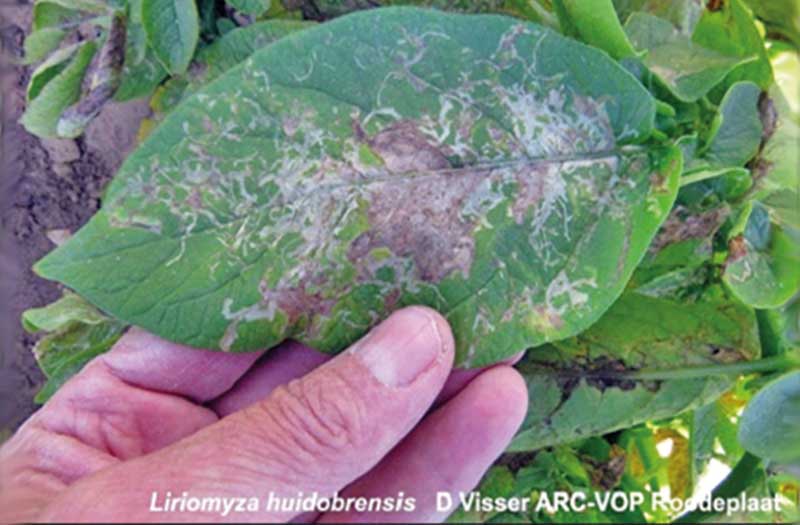
The potato leafminer (Liriomyza spp.) is a pest that punches well above its weight. Despite its tiny size, it wreaks havoc on potato crops globally

De Wet du Toit,Portefeuljeleier: Insekdoders Mielies is een van die belangrikste gewasse wat jaarliks in Suid-Afrika produseer word. Dit dra nie net tot die ekonomie

ACTIVE INGREDIENT

acequinocyl (quinone) 150 g a.i/l

PACKAGING

1L

REG. NO.

L 11701 Act No. 36 of 1947

REGISTRATION DETAILS

KANEMITE™ 150 SC.  Active ingredient: acequinocyl (quinone) 150 g a.i/l. Reg. No. L 11701 Act No. 36 of 1947. Danger. Hazard Statements: May be harmful if swallowed or in contact with skin. May cause an allergic skin reaction. Harmful if inhaled. Causes damage to organs (lungs). May cause damage to organs through prolonged or repeated exposure (blood system). Very toxic to aquatic life. Very toxic to aquatic life with long-lasting effects. Precautionary Statements: Wear impervious rubber gloves and boots, protective clothing and chemical safety goggles. Avoid release into the environment.

Registration holder: UNIVERSAL CROP PROTECTION (PTY) LTD.
Co. Reg. No. 1983/008184/07
65 Botes Road, Glen Marais, Kempton Park, 1619
Tel. (011) 396 2233

CROPS & TARGET

ApplesCitrusNectarinesPeachesPlumsApples - Bryobia miteApples - European red miteApples - Red spider miteApples - Two-spotted spider miteCitrus - red miteCitrus - Two spotted spider mitesNectarines - Bryobia miteNectarines - Two-spotted miteNectarines - European red mitePeaches - Bryobia mitePeaches - Two-spotted mitePeaches - European red mitePlums - Bryobia mitePlums - Two-spotted mitePlums - European red mite

Insights

Ons wil u graag herinner dat LUTON 240 SC nie op die amptelike, Horgtro MRL-lys vir pere verskyn nie. Alhoewel die etiket tans vermeld dat

The potato leafminer (Liriomyza spp.) is a pest that punches well above its weight. Despite its tiny size, it wreaks havoc on potato crops globally

De Wet du Toit,Portefeuljeleier: Insekdoders Mielies is een van die belangrikste gewasse wat jaarliks in Suid-Afrika produseer word. Dit dra nie net tot die ekonomie

By Dr Brian de Villiers January 2022 Many herbicides such as glyphosate, clethodim, some SU’s and various others are affected by salt antagonism from carrier

By Dr Brian de Villiers June 2024 Adjuvants are often omitted or replaced with an unregistered product without any negative consequences. Growers then assume that

By Dr Brian de Villiers March 2026 The word “adjuvant,” means “to help.” These products are therefore used exclusively to help crop protection products (CPPs)

By Dr Brian de Villiers February 2022   Adjuvants are registered with many crop protection products (CPP) and are added to an immense amount of

By Dr Brian de Villiers January 2026 In our interactions with stakeholders we sometimes learn that growers had replaced an adjuvant registered for use with

By Dr Brian de Villiers February 2025 Ammonium sulphate was first applied commercially with glyphosate as a water conditioner about 40 years ago. It’s hard

By Dr Brian de Villiers January 2021 There have been various recent allegations that ammonium sulphate is not effective because it is unable to overcome

By Dr Brian de Villiers December 2020 Over the past few years Villa has tried to encourage the correct use of adjuvants toincrease and stabilize

Deur Brian de Villiers April 2026 Daar is twee noodsaaklike prosesse wat die effektiwiteit van sistemiese gewasbeskermingsprodukte (GBP’e) verseker. Die eerste is bedekking, wat deur

By Dr Brian de Villiers Desember 2024 Ons beklemtoon dikwels die belangrikheid daarvan om genoeg spuitdruppels tot by alle dele van die plant te kry.